Concrete Grinding
The fastest, least disruptive way to remove a raised edge. We bevel the high side back to a smooth, clean, non-slip surface.
The problem
A trip hazard forms when one concrete section rises above its neighbor. The ¼-inch to 2-inch range is the most common on walkways, and it is exactly the range grinding is made for.
When it applies
- Vertical displacement between ¼ inch and 2 inches at a joint or crack.
- The surrounding concrete is otherwise sound.
- You want the hazard gone without closing the walkway, hauling out slabs, or waiting for new concrete to cure.
- Trees are nearby and you would rather not disturb the roots.
How we do it
- 1
Scarifier grind
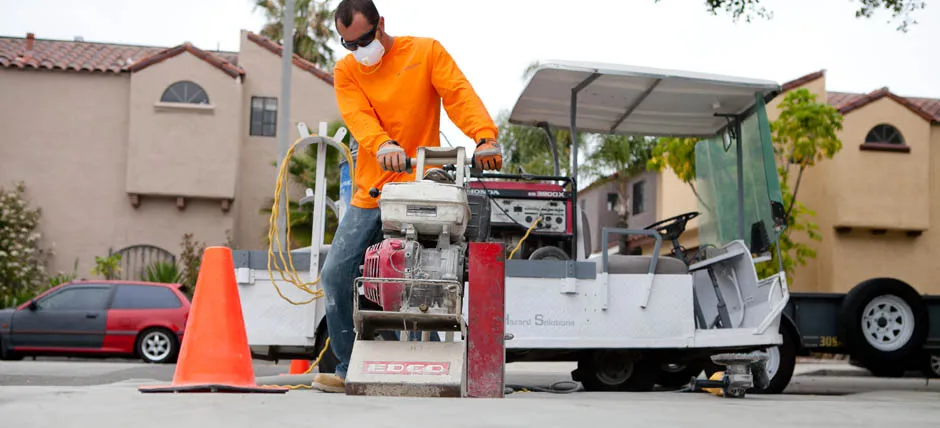
For larger displacements, a scarifier with attached dust control removes the bulk of the raised concrete.
- 2
Fine grind and polish
A dry hand grinder with an attached vacuum brings the bevel to a smooth, uniform finish with a straight back line and no scarring on the adjacent slab.
- 3
Clean, squared-off finish
The grind is squared off at the back for a clean look. The concrete on the other side of the joint is left untouched. The ground area is swept and the material removed.
Grinding is the core of what CHS does. It removes the raised edge instead of the whole slab, which means no demolition, no haul-off, no concrete truck, and no closed walkway while new concrete cures.
The difference between a good grind and a bad one is visible from across the street. A good grind has a consistent slope, a straight back line, and leaves the neighboring slab untouched. We grind to our own published specification, which is written to the changes-in-level requirements of the 2010 ADA Standards for Accessible Design (Section 303).
Our grinding specification
- Scope. Any vertical displacement of ¼ inch or greater in a path of travel. Displacements up to 2 inches can be repaired by grinding. Over 2 inches, we recommend removal and replacement.
- Equipment. A dry hand grinder with an attached vacuum to contain concrete dust. For larger grinds, initial removal with a scarifier with attached dust control, and the final surface completed with the hand grinder.
- Slope. Completed grinds are smooth and sloped back at a minimum of 1:8. A 1-inch displacement is sloped back at least 8 inches from the lip. A ½-inch displacement is sloped back 4 inches.
- Finish. The grind is squared off at the back for a clean look. The concrete on the other side of the grind is left untouched. The finished surface is initially lighter in color and the aggregate will show.
- Traction. The finished grind should not be slippery and should have about the same coefficient of friction as the undisturbed surface.
The full specification is available as a PDF for inclusion in bid packages and reserve studies.
Other services
Ready to make your walkways safer?
Tell us about the property and the walkways that concern you. We'll schedule a free site survey, document every hazard, and send a proposal you can take straight to your board or owner.
Or call 714-292-6150